

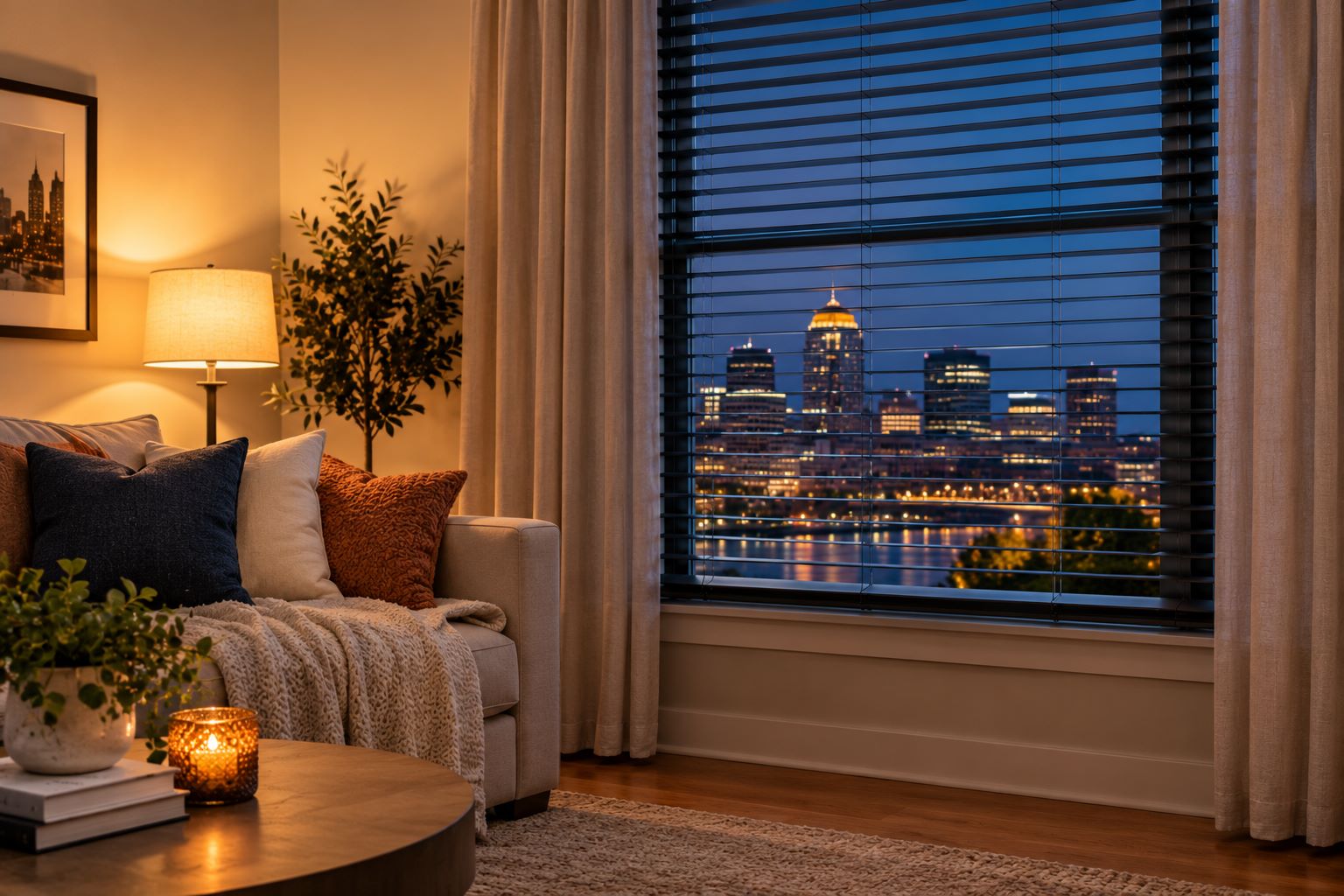
A window covering can look private during the afternoon and behave differently once the lights come on.
You may enjoy a softly filtered view through your living room shades during the day, only to realize that someone outside can see more of the room after sunset. Decorative curtains can create a finished look without covering the glass. A blind may be lowered but still need its slats adjusted.
October is a useful time to review these details. As evenings arrive earlier, more of your daily routine happens with indoor lights on and darkness outside.
The right privacy window treatments should suit both situations. They should help you enjoy daylight when you want it and limit visibility when you need privacy.
For Louisville homeowners, that means considering more than fabric color or product style. The material, window coverage, mounting arrangement, and operating method all affect how a treatment works.
Start with the room and its actual privacy needs, then compare the options.
Why Window Privacy Changes After Dark
The relationship between indoor and outdoor lighting affects what people can see through some window coverings.
A material that preserves an outdoor view during daylight may not provide the same privacy when the room is brighter than the exterior.
This is particularly relevant to sheer fabrics and solar screen shades. Hunter Douglas explains in its solar shade buyer’s guide that people outside may be able to see indoors through solar shades when interior lights are on at night.
That does not make solar shades unsuitable. It means their purpose and limitations need to match the room.
Daytime Privacy Is Not the Same as Nighttime Privacy
When comparing products, ask two separate questions:
- What can someone outside see during the day?
- What can someone outside see after dark with the room lights on?
Also consider whether you want to obscure detail, prevent recognizable silhouettes, or block the view into the room more completely.
“Privacy” can mean different things to different homeowners. Explain your expectations clearly rather than assuming the product description answers every question.
Identify Which Rooms Need the Most Privacy
Before selecting window coverings for nighttime privacy, walk through your home and identify the windows that matter most.
Consider the distance to sidewalks, neighboring homes, shared outdoor spaces, and other places where people may have a view indoors.
Living Rooms
A living room may need flexible daytime light and reliable evening coverage.
Street-facing windows can require a different approach from windows overlooking a secluded yard. Think about where you sit, which lights you use, and whether the television or seating area is visible outside.
Bedrooms
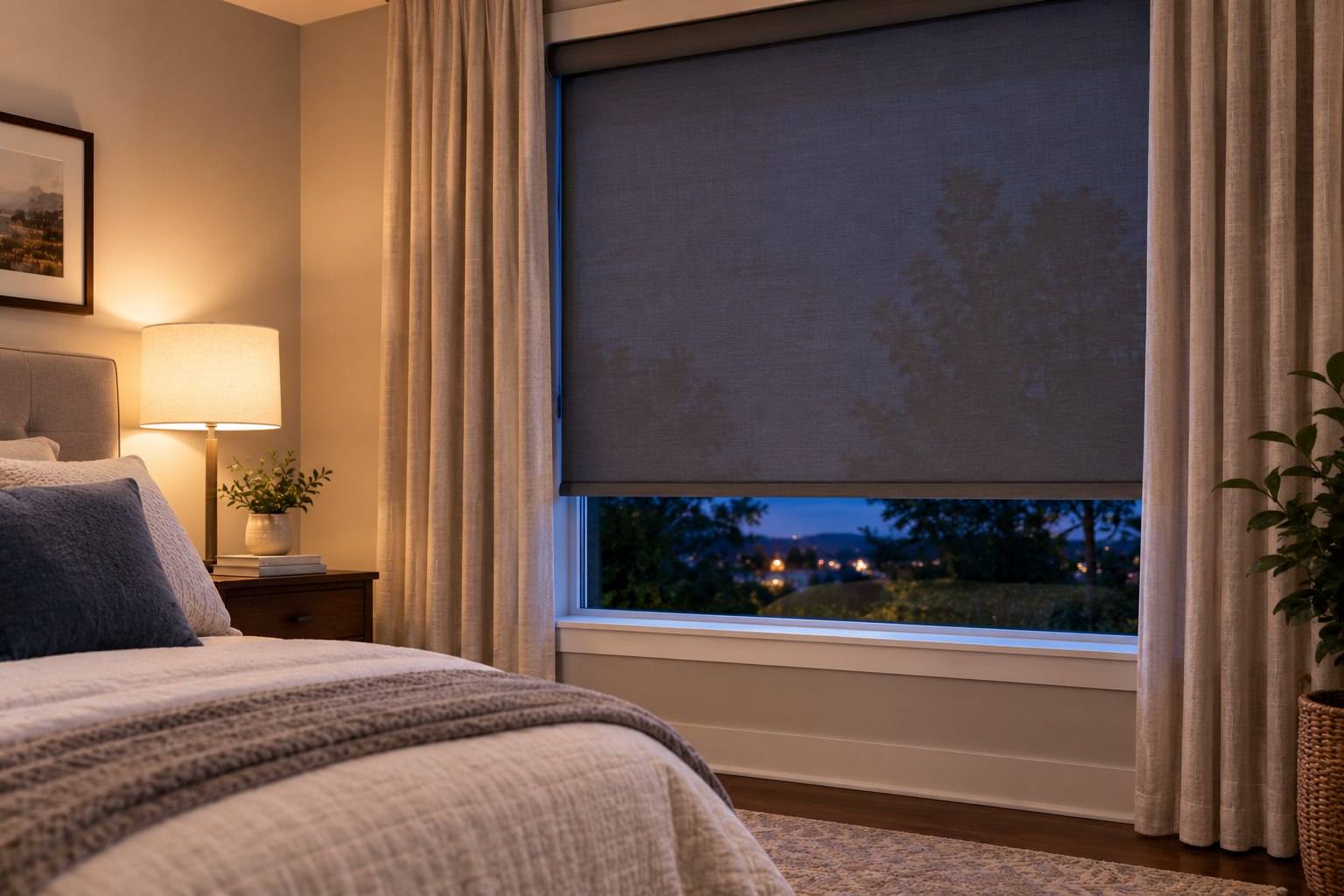
Bedroom privacy often needs to work alongside light control.
You may want a room that feels private while dressing, plus darker conditions for sleeping. Those are related goals, but they are not identical.
A covering that blocks views may still admit light around its edges.
Bathrooms
Bathrooms require careful attention to privacy, cleaning, and the room’s conditions.
Discuss the window’s location and exposure to moisture. Ask whether the proposed material and operating system are appropriate for that setting.
Home Offices
A home office may need glare management during the day and privacy in the evening.
If you work near a street-facing window, consider how screens, desk lighting, and the position of the covering affect visibility.
Understand Light-Filtering and Room-Darkening Fabrics
The distinction between light-filtering vs room-darkening shades is useful, but the actual fabric matters more than the label alone.
Light-filtering materials allow some daylight to enter. Depending on their construction and lighting conditions, they may also reveal shadows or silhouettes.
Room-darkening materials are designed to reduce transmitted light more substantially. Their privacy performance still depends on the specific material and how the window is covered.
Compare Samples in Real Lighting
A sample viewed on a table does not show how it will behave against a bright window.
Ask to compare materials with light behind them. Discuss what happens when the room is illuminated at night.
Consider the contrast between the window covering and your room lighting. A bright lamp close to a window can create a different effect from softer lighting farther away.
Treat Blackout Claims as a Whole-Window Question
A fabric can block light while the installed covering still allows light around its edges.
If your goal is a very dark bedroom, discuss the entire installation: fabric, mounting, edge coverage, and any additional components.
For privacy, the same principle applies. An opaque material does not resolve a direct view through an uncovered section of glass.
Compare Cellular Shades for Flexible Coverage
Cellular shades offer a fabric covering with a compact appearance when raised. Their suitability for privacy depends on the chosen fabric and configuration.
Louisville Blinds & Drapery’s cellular shade selection includes options such as cordless, remote-controlled, and top-down/bottom-up cellular shades.
Use Top-Down/Bottom-Up Operation Thoughtfully
A top-down/bottom-up design can let you cover part of the window while leaving another section open for light.
That can be useful when the lower portion faces a sidewalk or neighboring space. However, the uncovered area still allows a view through the glass.
Review sightlines before deciding how much of the window can remain open. An elevated neighboring window may create a different privacy concern from a ground-level sidewalk.
At night, you may prefer to close the covering fully rather than keep the daytime position.
Choose Fabric for the Actual Room
Do not assume that every cellular shade provides the same privacy.
Ask about the specific material, what remains visible through it, and whether its light-control characteristics fit the room.
For a bedroom, you may prioritize reduced light transmission. For a living room, you may want a different balance between daylight and coverage.
Choose Roller Shades by Fabric, Not Appearance Alone
Roller shades can provide a simple, uncluttered look, but products with similar shapes can perform differently.
A solar screen fabric that preserves a view is different from an opaque roller fabric intended to limit visibility and light transmission.
Louisville Blinds & Drapery offers roller and solar screen shades, making fabric selection an important part of the conversation.
Ask Whether the Shade Works Alone After Dark
If nighttime privacy is essential, ask whether the proposed fabric can meet that need without a second covering.
If it cannot, consider whether a different fabric or a layered arrangement would suit the room.
Avoid choosing solely by color. A darker-looking shade is not automatically more private than a lighter one; material construction and lighting conditions matter.
Review Coverage at the Window Edges
Ask how the shade will fit the opening and where gaps may remain.
A custom measurement helps establish the appropriate dimensions, but some operating systems require clearance. Discuss how that affects your privacy expectations.
Use Drapery as a Functional Layer
Drapery can add texture and color while providing another way to cover the window.
However, decorative side panels and functional drapery are different.
Side panels may remain fixed at the edges. Functional panels are designed to move across the opening. If evening privacy is the goal, confirm which arrangement is being proposed.
Louisville Blinds & Drapery’s drapery collection includes draperies, side panels, and other fabric treatments.
Discuss Fabric, Lining, and Closure
Ask how the fabric and any lining affect visibility.
Also review whether the panels will meet properly when closed and how far they extend beyond the window opening. A beautiful fabric cannot provide full coverage if the panels are too narrow to close across the glass.
Consider where the panels sit when open. They should work with furniture, doors, and the room’s circulation.
Layer Treatments for Different Times of Day
Layering shades and curtains can give each covering a specific role.
For example, a shade may manage daylight while a functional drapery layer provides additional evening coverage.
The combination needs enough space for both products to operate. Review mounting depth, hardware placement, and access before selecting the components.
Assess Blinds and Shutters in Their Closed Position
Blinds and shutters offer adjustable slats or louvers, allowing you to change the amount of light and visibility.
Their privacy performance depends on their position and fit. A lowered blind with open slats is not the same as a closed covering.
When comparing custom blinds and shades, ask to see how each option works in the position you would use after dark.
Check the practical details:
- Can you reach and operate the controls easily?
- Do nearby handles or furniture interfere?
- What gaps remain when closed?
- Can the treatment provide the coverage you expect?
For shutters, review panel operation as well as louver adjustment. For blinds, ask about the available operating systems and product-specific coverage.
Test Existing Privacy Window Treatments Before Replacing Them
You may be able to improve the way an existing treatment works before planning a complete replacement.
First, confirm that it closes and operates as intended. Check whether drapery panels actually cover the opening and whether blinds are positioned correctly.
Then assess the result after dark.
With help from another household member, view the window from a permitted outdoor location while the usual room lights are on. Avoid entering neighboring property or unsafe areas.
Record what is visible: details, silhouettes, uncovered edges, or a direct view through part of the glass.
This simple review helps you explain the problem during a consultation. It also reveals whether the issue is material transparency, incomplete coverage, or operation.
Make Evening Privacy Easy to Maintain
A treatment works only when it is used in the appropriate position.
Think about your routine. Do you close coverings when preparing dinner, watching television, or getting ready for bed? Are some windows difficult to reach?
Motorized shades for evening privacy may be useful for accessible operation or compatible scheduling, depending on the selected system.
Louisville Blinds & Drapery confirms that it offers motorized blinds and shades on its website. Ask which products support the controls and functions you want.
Confirm compatibility, power requirements, and how manual control works. If schedules are available, review them as seasonal daylight changes rather than assuming one setting will suit every month.
Prepare for a Louisville Window Treatment Consultation
When comparing window treatments in Louisville, KY, bring information about the problem you want to solve.
Useful details include:
- The rooms and windows involved.
- Photographs showing the existing coverings.
- Your daytime light preferences.
- Your expectations for nighttime visibility.
- Any concerns about access or operation.
- Your preferred style and budget.
- Your desired project timing.
Louisville Blinds & Drapery describes professional measuring and installation services, along with design assistance and drapery made in its workroom.
Those services are relevant because privacy depends on both product selection and coverage.
For homes in Louisville and nearby communities such as Middletown, St. Matthews, and Prospect, the important starting point is the actual window and its surroundings. Two homes in the same neighborhood may need different solutions.
Ask about current lead times if you are planning an October update before holiday guests arrive. Product selection and installation availability will determine the schedule.
Frequently Asked Questions
Can people see through shades at night?
They may be able to, depending on the fabric, coverage, and lighting conditions. Sheer and solar screen materials can allow a view indoors when interior lights are on. Compare the specific product after dark or ask for a demonstration. Do not assume daytime privacy guarantees the same result at night.
What are the best privacy window treatments for a living room?
The best choice depends on your daylight preferences, window location, and evening privacy expectations. An appropriately selected opaque shade, functional drapery, or layered combination may work. Review fabric transparency and edge coverage, then choose an operating method that makes it practical to close the treatment each evening.
Do solar shades provide nighttime privacy?
Solar shades should not automatically be relied on for nighttime privacy. Their screen fabrics can preserve a view, and people outside may see indoors when the room is lit. If you want their daytime benefits, discuss an additional opaque covering or another arrangement that addresses evening visibility.
Are light-filtering shades private enough for bedrooms?
That depends on the material and your expectations. Some light-filtering fabrics may reveal silhouettes under certain conditions. A bedroom may also require reduced light for sleeping. Ask to compare the specific fabric’s privacy and light-control performance, and consider the installation’s edge coverage before selecting a product.
Can I add drapery without replacing my existing shades?
Often, a second layer can be considered if the window and surrounding space allow suitable mounting and operation. Check the existing shade, hardware clearances, furniture, and required panel width. Functional drapery should be able to close across the opening; decorative side panels alone may not meet your privacy needs.
Why does professional measurement matter for privacy?
Measurement helps determine how the treatment will cover the window and operate around trim, handles, and other obstructions. Fabric selection still matters, but coverage gaps can undermine privacy even with an opaque material. Discuss expected gaps and mounting options with the installer rather than assuming custom sizing removes every opening.
Choose Privacy That Works With Your Daily Routine
The right privacy window treatments should make your home comfortable to use in daylight and after dark.
Before choosing, identify the view you want to preserve, the visibility you want to limit, and how the treatment will cover the window. Compare materials in realistic lighting and plan an operating method you will use consistently.
Explore Louisville Blinds & Drapery’s cellular shades, roller shades, and custom drapery to begin narrowing your options.
Contact Louisville Blinds & Drapery or call 502-677-4424 to discuss your rooms, privacy needs, and fall window treatment project.
